On the settling of love for the Guru
Gurudev: Even if I were to go three thousand kilometres away tomorrow, your form remains firmly held in your consciousness. So it's been three months now. A very deep love for Shri Adi Shankaracharya has formed in you. It has already settled.
Questioner: I only realised that just now, sir.
Gurudev: No, it isn't fully settled yet. Both sides stand before us. (The first sentence is partly unclear.) They wanted to prove through this that society creates the bond of maya (illusion). You hear this every day, after all. First it was accepted, and only then made public. (This sentence is unclear in the transcript.) Here is Baba Nagaraj Ji… Baba Nagaraj. There they made a mistaken interpretation. (Literally: "made a wrong interpretation.")
Power is recognised through energy
Gurudev: Whereas Shankaracharya writes: Brahma satyam (Brahman is reality). He distinguishes between the eternal (nitya) and the transient (anitya). He calls real that which is eternal. Heading is truth. (This fragment is unclear in the transcript — possibly a garbled rendering of the English word "heading".) That which is changeable, what is changing right now… (the connection of this fragment to the surrounding text is uncertain). Only through the oil is heading recognised. (Fragment unclear, likely related to the analogy that follows.) How is oil recognised? (The example is unclear in the transcript; likely an analogy.) In the same way that power is recognised through its energy. What manifests as energy also manifests as power. It is precisely through energy that we recognise power. If life manifests in all of you, it can only manifest because it has a body available to it. That is energy (shakti). And it is through it that power can be recognised. Power manifests in this way. Without energy it cannot manifest. If it does not manifest, it cannot be proven. If a generator is running but no electricity reaches here, then it cannot be proven that the generator actually works. Energy is not seen. And the moment a connection is made, the energy manifests, the light comes on, and all the electrical devices start working. That means the power has been proven. If nothing moves anywhere… (the last part of the sentence is unclear), power still always proves itself through energy.
If you denied energy, if you didn't study and didn't sit exams — how would anyone then determine what you know? Without an exam, no one can claim to have mastered something. (Literally a folk saying about not calling something a horse without testing it — the transcript is garbled here.) Why is that so? What are we actually doing?
The four ashramas and understanding maya
Gurudev: How can you cross over maya (illusion) without understanding it? Without understanding maya, Brahman cannot be understood. That is precisely why the four ashramas (life stages) were created. First comes brahmacharya (student life), then grihasthashram (householder life), then vanaprastha (withdrawal into seclusion), and finally sannyasa (renunciation). (The order in the recording's transcript is partly inaccurate; the meaning corresponds to the traditional four ashramas.) That is why the great sages created this whole system — all four life stages together… (the rest of the sentence is unclear in the transcript). It is said that the period of vanaprastha begins around the age of fifty to sixty.
Our great sages examined every single thing in a highly scientific way, understood it, and then put it into practice. And then they presented it to people, saying: "This is how it is." That is why a person first lives in brahmacharya and learns the theory. Then, once he has understood the theory, he enters householder life. There he already moves into practice. He enters maya. And only then does he come to know what obstacles and difficulties stand before him.
Look at Bhagavan Shankaracharya. He passed directly from brahmacharya straight into sannyasa. Bhagavan Adi Shankaracharya gave society a very important message — that a person should pass through all four ashramas. (The transcript contains several unclear words, but the meaning corresponds to this statement.) I myself was destined to enter householder life. It was only once Adi Shankaracharya had entered householder life that he was able to fully understand this fact. Only then did he understand maya.
Maya as teacher, not deceiver
Gurudev: It is said: "Maya is a great deceiver — this I have come to know." (An allusion to a well-known Sanskrit saying/verse: "माया महा ठगनी हम जानी".) But maya is not there to deceive you. Maya gives you lessons in life. It tries to help you understand the individual sides of life, the four parts of life's journey, and helps you fulfil them and live them through in depth. (The end of the sentence is partly unclear in the transcript.) The essence of maya is constant change — everything that exists changes with every moment. It is through maya itself that life is lived.
Why does a scientist keep experimenting? Because whatever he is examining right now, testing it… by the next moment it has already changed. In the next second it is different again. Not breaking it into pieces — it has to be looked at part by part. If you divide it into individual parts, you won't see the overall effect. Only the effect of the individual parts remains, not the effect of the whole.
The whole and its parts: the rocket example
Gurudev: Let's take an example. When we want to check something… when some kind of craft is launched from here (the transcript's word "yaan" may mean a rocket or spacecraft)… When they launch it, they track the place where it is to land. They don't aim directly at the place where it is to land — they calculate the time when the target location will come into the correct position, and when the rocket will arrive there from this location. If you aimed straight at the place you wanted to reach, the rocket wouldn't get there, it would come down somewhere else. It is the same with testing: what you are testing right now ends up, in the end, somewhere completely different, and then someone else interprets the results of that test, and people take them to be correct. (This part of the transcript is unclear in places.)
In the same way, our great sages presented their teaching together with their own experience, as evidence. What did that show? If we ourselves had not gone through householder life, had not entered society and shared the experience of householder life, and had not gone through the period of vanaprastha… (the transcript contains several unclear words), then many things would have to be worked out and guessed at. Through entering another body, Adi Shankaracharya fully understood householder life and truly lived it through. (An allusion to the traditional story of parakaya-pravesha — entering another's body.) And then someone says he never lived through householder life, that he avoided it — that is nonsense. No, he truly went through it and lived it fully. If it hadn't been necessary, there would have been no reason to enter another body. Why would another body even be needed? It would have been enough to leave, understand it, and see it. There is a very subtle difference in this. Those were great sages — they gained this experience and passed on the proof.
So what follows from this as a principle? That a person should pass through all four ashramas. From brahmacharya he should enter householder life, then he should go through the period of vanaprastha, and finally he should enter sannyasa. Some people go off into asceticism or take sannyasa already as children, but then they don't know what lies in between — and that is not the ideal that the great sages showed us. That is exactly where their legacy lies.
The turn to meditation
Gurudev: All right, all right. So let's go, brothers, now let's show you something. The understanding has already arisen in meditation. (Literally: "The understanding took place in meditation.") Please, get ready.
A disciple's experience: the body expanding
Gurudev: Horizon… (the first word is in English in the transcript: "Horizon"). And even though the one observing all of this remains the same, a feeling arises that the body is becoming very, very, very… (the last word is unclear in the automatic transcript — it does not resolve to any meaningful Hindi word; from context it may have meant something like "very subtle", "very light", or "as if disappearing", but this cannot be reliably determined from the recording). Your own being (literally "body" in the transcript — sharira) has ten activities. These five parts of your life — atma (soul), buddhi (intellect), chitta, vritti and mind — make up the five parts, and within each of these five parts two activities take place.
The five parts of life and their twofold activities
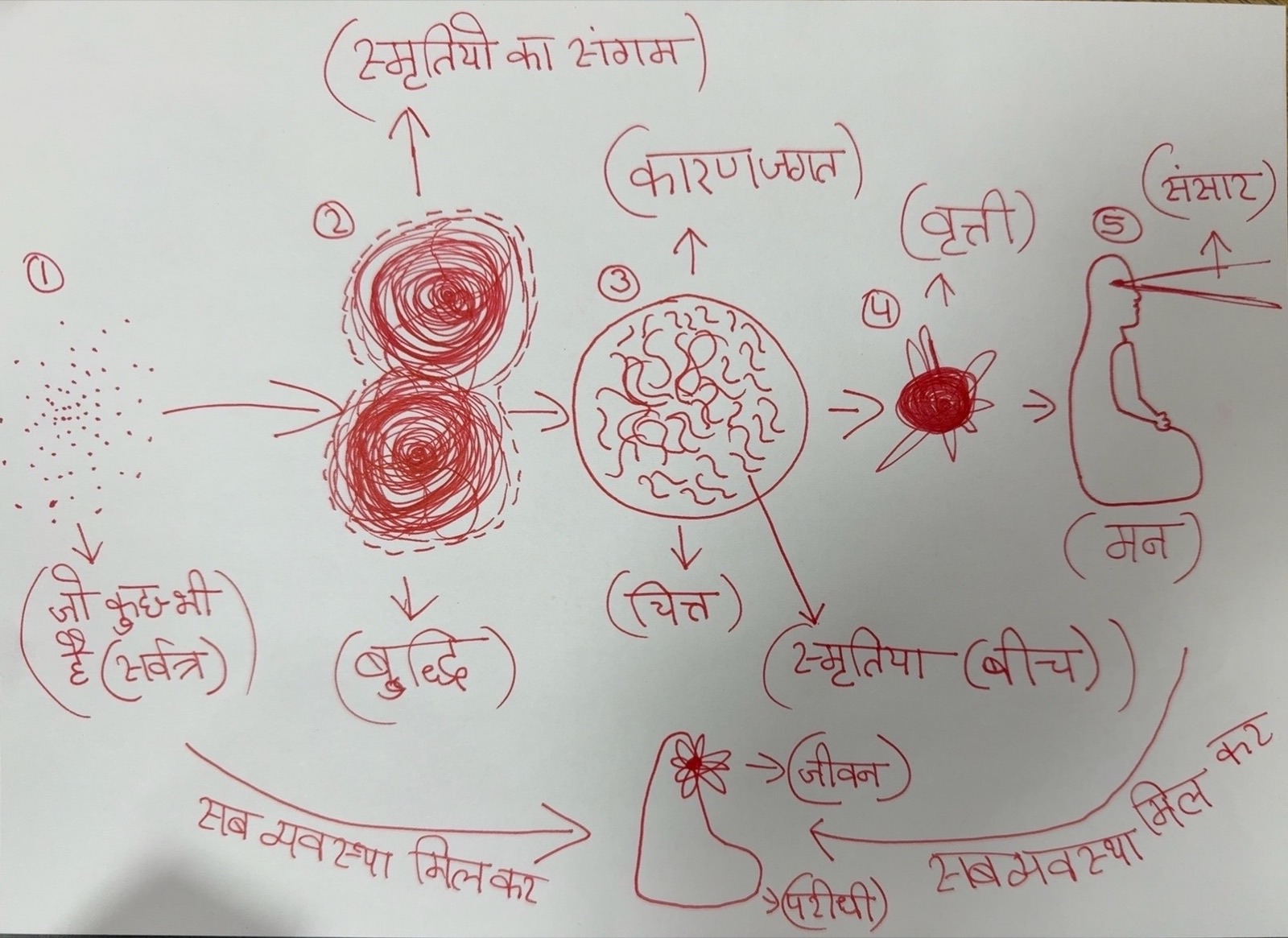
Gurudev: In the mind (manas) there are two activities — testing and selecting. Only these two: testing and selecting take place in your mind. In the same way there are two activities in vritti: analysing and comparing — those are the two activities of vritti.
In the same way there are two activities in the next part, which is chitta. In chitta there are two activities: the first is chintan (contemplation) and the second is chitram. The words chintan (contemplation) and chinta (worry) sound similar, but their meaning is different. When we worry (chinta), we worry about the body, about the future — worry cannot exist in the present moment, worry means you are not in the present. Contemplation (chintan), by contrast, means you are in the present moment. That is the whole difference between worry and contemplation. So in chitta there are two activities — contemplation and chitram.
What is chitram? When we create something, like a drawing, for instance. For example, we imagine that once we build a house, it will have four rooms, here will be the kitchen, there the garden… all of that is created in the mind, that is chitram. And once the house is built and a colour is being chosen, inwardly we imagine: shall we paint it red, or blue, or green, or white? Here this would look better, there that would look better. This is how you imagine various possibilities. All of these activities take place in chitta.
Your desires reside in chitta. All your memories are stored in chitta — all informational memories and all memories of experience are stored precisely in chitta. No memory remains in the brain — remember this, never. No memory ever remains in your body. The memory of individual organs remains only within those organs for as long as life persists in the body — it is thanks to the light of life that these memories are active, that is why the body works and all its organs function. But once life leaves the body and its light disappears from the body, darkness begins to set in — the organs that kept the body functioning pass into stillness, and their memory ceases. That is why all memories persist through chitta, because chitta is one of the parts of life — the causal body (karana sharira). So chitta has two activities.
In the same way there are two activities in buddhi. The fourth part is buddhi, above chitta. In buddhi there are two activities — one is called ritambhara (the transcript has a garbled rendering of this, but it evidently refers to the Sanskrit term ऋतम्भरा — ritambhara, "filled with truth"), the other is called bodha (knowledge, realisation). When we attain something as true knowledge (bodha), we become fully resolved toward it — our will strengthens, and from that moment we act according to that resolve permanently. Once we understand that this is the truth, we never depart from it again. Once bodha arises, the second activity of buddhi is ritambhara — a resolve filled with truth, with truth alone. Those are the two activities of buddhi.
In the same way there are two activities in atman. One of the five parts of life is atma — the five parts: atma, buddhi, chitta, vritti and mind. In atman too there are two activities: the first is experience (anubhava) and the second is proof (pramana). The moment you truly experience something, you have first attained bodha — the knowledge that it is true. How did this knowledge come about? Through direct realisation, through direct experience (sakshatkara). When you think about something for a long time — whether it is right or wrong — you eventually arrive at the knowledge: "No, this is not right." You decide: "I will not do this any more." And the proof is your own experience — that you truly no longer do it. So you have both the experience and the proof that you no longer do it — that means it has become your reality. After bodha and ritambhara, you enter atman, where there are two activities: the first is experience, and the moment experience arises, proof immediately appears with it. Those are the two activities of atman.
And now the second matter. You say you have a feeling as though your body is expanding more and more. But you remain only one. If you are expanding, who is it that observes this? Who sees that something is expanding? Then there would be two — one who sees, and another who is seen. There are two things: that which is seen, and the one who sees; the meditator and the object of meditation. That means you have entered duality (dvaita). And the great sages say: "Prem gali ati sankari, ja men dvaya na samae." (The lane of love is very narrow — two cannot fit inside it.) In a state of duality, you cannot enter there. There is division (dvandva), and then there is unification (fusion) — one cannot travel there as two.
So what remains? Say you are meditating, and suddenly you find: "Why, I have ended up in Bombay!" How did I get there? All right, let's meditate again… And again you are in Bombay. Who is it, really, that sees you there? Who is observing you? On the surface there appear to be two. But there are not. This needs to be understood: above the mind watches the gaze of vritti, above vritti watches the gaze of chitta, above chitta watches the gaze of buddhi. And above buddhi, in wholeness, who watches? Atma. That is the witness (drashta), it is in wholeness. Atma watches over buddhi from above, buddhi watches over chitta, chitta watches over vritti, vritti watches over the mind, and the mind watches over the world. This is how the whole cycle arises.
Who is the observer: atma as witness
Gurudev: What you saw is entirely true. Because who is it that sees? It is your state of the witness (drashta-bhava), it is your witnessing consciousness (sakshi-bhava). It is that which observes you, that which sees you. You saw it entirely correctly, it is not wrong at all. You are right, a hundred per cent correct. You saw it very beautifully, you gave your attention to it very beautifully in meditation. Thank you very much.
A disciple's experience: the journey to the navel
Gurudev: In the same way, in the same way… this very boy has just described his experience. He described it in full. At the end I said: travel into your navel, into your navel — not: focus on the navel. And what happened? That was his experience, it is a very beautiful experience.
A disciple's experience: He writes here: "Gurudev sent me, through his meditation, to the navel. At first, though, I couldn't get inside, I couldn't enter, I couldn't travel inside. Then I had the feeling as if, at the navel, a door opened, a gate that pulled me inside. When I entered inside the navel and got there, I saw thousands of gates. Behind each of these gates, in the subtle body, is one of the thousand nadis (energy channels). So I saw thousands of gates and didn't know which way to go. But then I entered all those thousands of gates at once. And all those gates opened before me." (The end of the sentence is slightly unclear in the transcript.) "I entered all the thousands of gates simultaneously. I didn't travel by just one gate — I went by all of them, I passed through all the nadis. I travelled through the whole body simultaneously, by a thousand paths, all those paths at once. And by these thousand paths I arrived at a place. And there was nothing there… nothing at all. There was something that was like nothing, there was some kind of substance there that gave the impression of being nothing. It felt to me like water. I passed through it and then returned by the same thousand paths, I kept returning between the individual organs, through the various passages between them. Eventually I reached the navel again. But I had the feeling that, from outside, the gate of the navel was already closed. I remained trapped there and couldn't get out. Perhaps you then pulled me back through that gate, and that is how I got out."
Gurudev: When he got stuck there, I called him back, and that is when he came back out. That too is one of the experiences — just as we have already let you experience many times, seeing your own organs from within. You have seen for yourselves which organ is unwell and which is healthy, you saw this through your own experience during meditation. When I showed it to you, you saw it for yourselves — whatever you turn your attention to, wherever you shine the light, that is what you see. That is why your state of the observer, the state of the witness (sakshi-bhava), is precisely atma. Atma is the witness, atma is the observer.
Atma never travels — only memories travel
Gurudev: But remember one thing — atma never travels. What some books say travels is not atma. Only memories travel. If there is no memory of Indonesia within you, you cannot travel there, you cannot even think about Indonesia. You can only return to where you have already been. Life, however, is present everywhere, because life is radiance — it is part of the Infinite, it is spread out absolutely everywhere. So why would it need to travel? Only that which exists in one place can travel; what is spread out everywhere — why would it travel?
Space is extended in every direction, that is why space never travels. Within space the sun, the moon, the stars, the earth, the planets and the constellations travel, but space itself never travels. In the same way, atma is part of this infinite space — that is why atma never travels. It is memories that travel, and all memories travel at the same time. Of these, the negative, diseased ones are destroyed by your sankalpa (conscious resolve), destroyed through your meditation practice. That is why it is said that the only way — the highest way — to destroy the fruits of karma (karmabhoga) and the memories bound up with them, is meditation, and meditation alone. It is only during meditation that your karmic residues dissolve, through the grace of the Guru. There is no other way.
Closing instructions
Gurudev: Today we have explained this to each other very well. Tomorrow we will meet again. We wish that tomorrow, early in the morning, you will all sit down for Rudrabhishek — you will all sit for Rudrabhishek from 3:30 in the morning, all of you, every single one.