Editorially arranged transcript of a conversation in which Gurudev answers questions from students. The text is divided into logical thematic blocks according to the individual questions. The original wording has been preserved; what has been adjusted is primarily the division, paragraphing, and typographic hierarchy. Unclear passages and transcription notes have been retained. Names in the questions concerning personal health have been replaced with initials.
Free will, karma, and the divine plan
The first part of the question consists of two different parts. The first concerns what Pavlína raised: if a person creates his own reality, as Gurudev often says — that you are the creator of your own happiness and unhappiness — then in the present situation, in reality, that situation does not come from outside, but you yourself are its creator. As Gurudev often repeats. Then, under such conditions, where we have our own free will, and if there is some plan that has been set for us, where we are meant to play some role in the future, what is the subtle boundary between the two? How can we recognize whether something is karma, created by us, and the consequence of karma, or whether it is the consequence of some divine plan, through which nature gives us some task and directs our life and its state in that direction? How can we understand that difference? That is the question, Gurudev.
“Very beautiful. It seems you have devoted quite a lot of time to this.” “The point is that whatever exists in the world, whatever concerns us, concerns us ourselves — its creators and its destroyers are we ourselves. That is the basic rule. We have a greater power to create problems, but a somewhat lesser power to find solutions. And that is precisely because our attention turns again and again toward problems. That is why we see problems everywhere, we see only destruction. If we turn this view toward solutions, keep it focused on creation, and keep it positive — then it becomes so through drashtā bhāva, the attitude of the observer.”
There is only one way. There is no other way in the world: through sākshī bhāva, the attitude of the witness, through your attitude as observer. Then you clearly see who creates — whether it is I, or whether something comes from outside. On the day you see this completely clearly and truly become the observer, then you will clearly see the creation and destruction that you yourself cause. And that is precisely the solution. Nothing comes from outside. Nothing goes out. Everything is inside and will remain inside. There is no way it could go outside. “So, Rajeev ji, the question is formulated very simply, and its solution is equally simple. When you look at everything through drashtā bhāva — the attitude of the observer — everything begins to regulate itself. You don’t need to control anything. Everything works like a mechanism; it is self-regulating.
And everything you see is precisely māyā. What is visible is māyā. It changes at every moment, changing its form with every moment. You stand on the riverbank — the water has flowed away. You turn your head this way and look again. The river is still the same, but the water you saw before has already flowed away. Likewise the air flows — and is gone. You breathe in once and breathe out, and meanwhile the air that was here has already moved on. Everything changes at every moment. If drashtā bhāva is present, then you understand all of this, you see it. And then you understand that we too are part of prakriti — nature. At present we consider that nature is here for us, that we have come to use this nature. That this nature exists only for man. We forget that man too is part of this nature. When you separate man out, nature becomes incomplete. Nature therefore includes everyone together, as a whole, in totality, including man. That is why we are able, through drashtā bhāva, to observe everything in nature very well and to see that we are part of it. That is why it is necessary always to keep in mind that whatever creation, destruction, or establishment of some rule or principle takes place, it will be determined precisely by your drashtā bhāva. That is why drashtā bhāva must be kept strong. That is the only means for solving every one of your problems. Whenever a problem or question arises before you, first go deep into its essence. Try to look at it from a distance, in the attitude of the observer. See whether what we are doing, we are doing under the influence of fear and greed, or whether we are doing it for the good of all. Whether we are doing it for the benefit of humanity and the whole of creation. Then you will see it. If you are doing it for yourself, for a few of your close people, acquaintances, friends, or family — if you are doing it for them — then it is your own benefit and gain. But if you are doing it for the totality of the whole creation, of which you yourself are a part, if you want to do it for that, and think about it in this way, then it will proceed in accordance with nyāya, dharma, and satya — justice, righteousness, and truth. So, according to what your drashtā bhāva is, you will see how things arrange themselves and how they appear before you on their own. But when you look through drashtā bhāva, then it truly is very remarkable. It is precisely on this that the greatest attention needs to be focused.”
“Is there any part of the question left? In my view, the solution lies in exactly this. The solution lies in exactly this.”
“It is entirely on the level of principle. When we now look at this plan in such a way that we separate ourselves from nature, we do not become part of it, even though we are part of nature.” “The answer is already contained in that, Gurudev, in your explanation.” “Good, Gurudev, exactly so.”
What happens to consciousness in the transition from meditation to sleep?
“Or more precisely: what happens to consciousness? When we naturally move from meditation into sleep, what actually happens then to the body and to consciousness?” “One cannot pass from meditation into sleep. From sleep one can move toward meditation.” “What a secret you have just revealed.” “When we now enter sleep, sleep is a state of unconsciousness.”
“Meditation is a wakeful state.” “How could someone who is awake pass into sleep?” “So how could someone who is awake, who has already gained experience, now do childish things?” “And so, through these childish activities, one gradually grows, gains more and more experience, rises to its peak, and can then enter meditation, can enter samādhi.” “So all these things we are trying to understand — there is a means to understand them. And when we use this means… The meaning of the word upāya — means — is such that today we used it and reached where we needed to reach. With that, the work of this means has ended. We have become complete, we have put ourselves in order.” “For example, when we fall ill, medicine is a means.” “You take the medicine, you get better — and then you leave this means behind, don’t you?” “After recovering, a person doesn’t go on taking medicine. If a person fell in love with the medicine and said: ‘Sir, I will keep taking it forever, I won’t stop taking it, because I like it so much, brother’ — [that wouldn’t make sense].” “It is the same with anything we accept as a means. For example, dhyāna sādhanā — that too is only a means. At present our means is that we sit down, cross our legs, sit in sukhāsana, in a comfortable position, and gradually carry out the given process and enter meditation. That is the means. Then this means stays down below, and you go elsewhere.” “Gradually you become so accustomed to it that you are sitting — and within a nanosecond you automatically rise upward. You are lying down — and you leave right from lying down. You do the meditation and leave. You are traveling in a car, sitting — and you leave.
You are using a mobile phone — and you leave right while using the phone.” “You become so concentrated that you simply leave — you enter meditation.” “So at the beginning of meditation it is necessary to cross your legs, to sit in a good place so that mosquitoes don’t bite you, so that flies don’t bother you… But brother, once a person enters samādhi, you can bite him all you like and he won’t even know it. What can a mosquito or a fly do to him? What can mosquitoes and flies do? So go ahead and bite. And that is the whole secret.” “A person has freedom to perform karma.” “But when it comes to experiencing its fruits, there he is no longer free.”
“This applies to human beings.” “Other living beings do not have freedom to perform karma, and therefore there is no fruit of it for them either. So they don’t have to experience the fruits of karma.” “They are part of the process.” “But with a human being it is such that he has freedom to perform karma.” “He acts according to his own will, he acts on the basis of his own memory.” “That is why he must also experience the consequences of his karma.” “So if we have freedom to perform karma, your freedom lasts only up to this moment. As soon as you have taken the first step, your freedom has ended. Now prepare to experience the consequences.” “Now you must live through them.” “That is why we have freedom in performing karma, and we can use it correctly, but we can also misuse it. A human being does both.” “When he has little understanding, he misuses it. When he gains greater understanding, he uses it correctly. Everyone wants to use it correctly. Everyone wants to do good. There is not a single person in the world who wants to do something wrong. And even when he does something wrong, he considers that wrong thing to be right and thinks: ‘I am doing the right thing.’” “He does not consider it wrong. He does not believe it is wrong. Try to discuss it with him — he will argue with you and say: ‘I am right.’” “He justifies it to himself.”
“On the day he understands that he is doing something wrong, he loses the courage to continue doing it.” “That is precisely the moment. That is why there is freedom in performing karma and unfreedom in experiencing its fruits. It has been established this way and will always be so, as long as the human race exists. That is why, whenever we want to take some step, it is enough to stop for a few moments before the act itself, think a little, and only then act. And that is precisely why dhyāna sādhanā is the right path. What is dhyāna? What does dhyāna actually mean? Being in the present moment.” “They left the future behind, set it aside, and entered dhyāna. But if you are trapped in the past or in the future, you are not in dhyāna. You are merely paying attention to something — dhyān de rahe hain — but you are not practicing dhyāna.” “Exactly, exactly.” “So one must move from paying attention to meditation, from nidrā — sleep — toward dhyāna, from unconsciousness toward consciousness, from unawareness toward wakefulness. Good. Pavlína writes very good questions. It is a good discussion.” “If anything remains unanswered, anything at all, Pavlína can point it out. If anything is missing from the answer to her question, she may bring attention to it.”
“In case something was missing here in the answer, the questioner may ask a further question or expand her question…”
Quantum physics, māyā, and Brahman
“There is talk of the quantum world, which from certain points of view is completely different — very different — from the world we experience through our senses. Is it correct to somehow connect these two areas with each other, or are they two completely different areas that I should not mix together? That is the first part of the question. And Gurudev, its second part: if there are such subtler levels of reality that we begin to experience through sādhanā, are these levels still part of māyā as well?” “Very good!” “In other words: is it possible, through experiencing ever subtler levels of reality, to arrive at Ātman — Brahman, that is, to arrive at oneself? Or does everything that can in any way be considered something that can be experienced or known still belong to the domain of māyā? And there is yet another part to this, Gurudev: Is the goal of exploring ever subtler and subtler levels of reality to attain Brahman? Or will we ultimately have to go beyond even the levels of the subtle world, transcend them, and go beyond them? Because whatever can be experienced as an object of knowledge — is that too still part of māyā?” “Very good. You are able to devote truly considerable attention to this.”
“There are two things. One is the creation that has already been created, and the other is what man has created, what has been created by human beings. One is the system that already exists — the whole of creation. It is the arrangement in which we breathe free air, receive sunlight, receive water. It is an already-existing arrangement. And then there is what we create ourselves. For instance, we have produced mineral water, we prepare food for ourselves, cook it, and eat it. We — human beings — created this food. And as for what we call quantum, quantum physics…” “How do you say quantum physics in Hindi? What is it called in Hindi?” “Atomic physics, Gurudev.” “But it is incomplete.” “Why is it incomplete? It is incomplete because the research is still ongoing.” “What has not yet been fully explored means it has not yet been fully understood. And from that no final conclusion can be drawn.” “No conclusion can be drawn, because your very conclusion would be mistaken.” In the following sentence several words in the transcript are unclear, so the meaning is not further supplemented by conjecture. “But how could something like that even be possible?” “Look, life is not mathematics.” “All right? Life is a collection of experiences. And not experiences from only one life, but a collection of experiences from many, many births.”
“It is not a small package, not a small sum, not a small little bundle. It is a very large knot, which we call bhoga — the experiencing of the fruits or consequences.” “And we experience it continuously.” “So it is very important to understand that everything we are only now trying to come to know is incomplete. What we have already come to know is complete.” “And that is precisely the essence of science. In science it holds that the knowledge we have gained — we have come to know certain things, we have come to know their laws, and through repeated practical verification we have found that it happens the same way every time. Every time you multiply two by two, you get four. Now there is no longer any doubt about it. That is called science.
“Quantum physics is here to help us understand that we are going in the right direction, because in the quantum you find some things that match what you yourself come to know.” “You find some things there. Today, for example, a gentleman was sitting here and said: ‘Gurudev, please look and see what is wrong with me.’ At the Darbar he was told: ‘Your kidneys are failing and your liver is going. That is your problem.’ He replied: ‘Yes, that’s correct. My kidney is already damaged. The doctor says I need a kidney transplant. But according to the tests my liver is completely fine.’ I said to him: ‘Brother, listen.’ And here quantum comes into play again. The engineer knows that a seven-story building will be built, what it will look like, where the rooms will be, how one will go up and down. Yes. The builder knows only as much as he is currently building.” “What a beautiful example, Gurudev.” “The engineer knows everything in advance. Ask him: ‘Will it be a seven-story building? Will there be a penthouse on top? What will it look like? What will be here and what will be there?’ He knows all of that. And if you go to an ordinary laborer, he will only tell you: ‘I will build this wall and my job is done. Then I’ll go home.’ So the level of information is the quantum. Yes.”
“But the level of knowing is dhyāna. That level of knowing is precisely dhyāna. And that knowledge comes through dhyāna sādhanā. Then the question arose: ‘Is māyā also part of māyā?’ What changes at every moment is māyā. What does not change is satya — truth. What does not change is Brahman. That is truth. That is Truth, the Supreme Truth. Truth is also māyā.” “But what constantly changes, we have given the name māyā.” “We have simply given it the name māyā.” “It too is true.” “Because it is part of Truth. It arose from Truth. It is pure Truth. This is exactly where almost everyone gets confused, trying to understand it as two separate things. It is pure Truth. And when Truth is beautiful, then māyā is also beautiful. Satyam Shivam Sundaram.” “What arose from Truth must also be Truth.” “If māyā arose from Brahman, then it too is Truth.”
“It depends on your point of view. If you look at māyā through these two separate viewpoints, you will remain confused. If you came with this separated viewpoint, we would not accept it. But when you look with the viewpoint of Brahman, then you will understand māyā. Then you will realize: ‘Why, this is not separate at all.’ It is not separate at all. On one side is the head, on the other side is the tail.” “It is not separate. Nor is it even possible for it to be separate.” “It is not even possible for it to be separate.” “That is why even all the subtlest levels — however immensely subtle they are — are all influenced by māyā. However subtle some level may be, it is still influenced by māyā. That means Shakti is active there.” “And wherever Shakti is active, there is māyā. Māyā itself is Shakti. And what is motionless — in which māyā runs about, rejoices, teases, plays, does everything — māyā does everything — all of it appears as if it is happening. But that in which all of this happens is precisely Brahman. That is Shiva.
“That is true understanding. That is comprehension.” “And who is the one who comprehends the Truth? Even deeper, Gurudev… Who comprehends? Who is the one who comprehends the Truth? You speak of Truth — but who is the one who comprehends it? Brahman is still not there, because in duality the one who comprehends and the observer appear as two separate forms.” “Look, Gurudev. Who is the observer? Then it becomes clear that he is beyond māyā.” “He is beyond māyā. It is like drops of water on a lotus leaf. They lie on the lotus, but do not merge with it. The lotus does not absorb them. They cannot dissolve into it.”
“There it stops, because this part is part of Brahman.” “The ātman, too, is part of Brahman. Our understanding and our knowledge are also part of Brahman.” “Māyā does not enter there. Māyā is with it, yet remains separate from it.” “Māyā thus has all possible levels, even the very subtlest. So remember it in a single sentence: quantum physics is at present still incomplete. It is as if there is one great book, and quantum physics is only one leaf of it, a single page. That is why it confuses people. And what needs to be understood is māyā itself. On the day you understand māyā, you have drawn close to Brahman. On that day you have drawn close to Brahman.” “And on the day you begin to act according to the dictates of māyā, you move away from Brahman like a mountain.” “So there is a great difference between living on the basis of knowledge and living on the basis of mere belief.” “The one who lives according to what he merely believes is in māyā. The one who lives on the basis of true knowledge is in Brahman. That is jñāna — knowledge. And that quantum is still in the domain of: ‘We assume that…’” “But life is not any ‘let us assume that.’” “Nor is the body any ‘let us assume that.’” “The body has its own limits, and yet we have placed within this limited body that which is limitless.”
“And in a certain sense even this body, which experiences a hell resembling actual hell, can lead you all the way to heaven.” “In itself it is very impure. It contains phlegm, it contains excrement, it contains urine, it contains pus, it is full of impurities. And then we bathe it from outside, clean it, smooth it, rub it with soap and oil, adorn and decorate it — but inside it is impurity.” “How much impurity is inside! The quantum thus helps you understand through logic.” “It helps you understand that something exists.” “It helps you understand that. Nothing more.” “It helps you understand things that can be viewed from two or three different perspectives. It will help you get somewhere close to them. It only helps you understand; it cannot comprehend it itself.” “Because through these two eyes it cannot be comprehended.” “Through these two eyes a person cannot become the drashtā — the observer. That is the point. So that was a very good question, very beautiful. You have thought about it a great deal. Jan really thought about it a lot. Thank you, Jan. Very good. Thank you. Jan gave us, through this question, the opportunity for a very good discussion.” “I think it is now understandable: where we live on the basis of what we merely believe, there is māyā. Where we live on the basis of direct knowledge, there is Brahman. There I am myself, and I am awake.
Where I live only on the basis of belief, I am in unconsciousness, I am not myself, and I am in the embrace of māyā.” “In the embrace of māyā.” “Thank you very much. Thank you, Jan. Thank you. Thank you for a very good question. If you have any doubt, you may ask again. If you have any further question, Jan, you may… If a further question arises from this answer, you may ask it once your translation is complete.”
Mind, perception of the world, and anubhūti
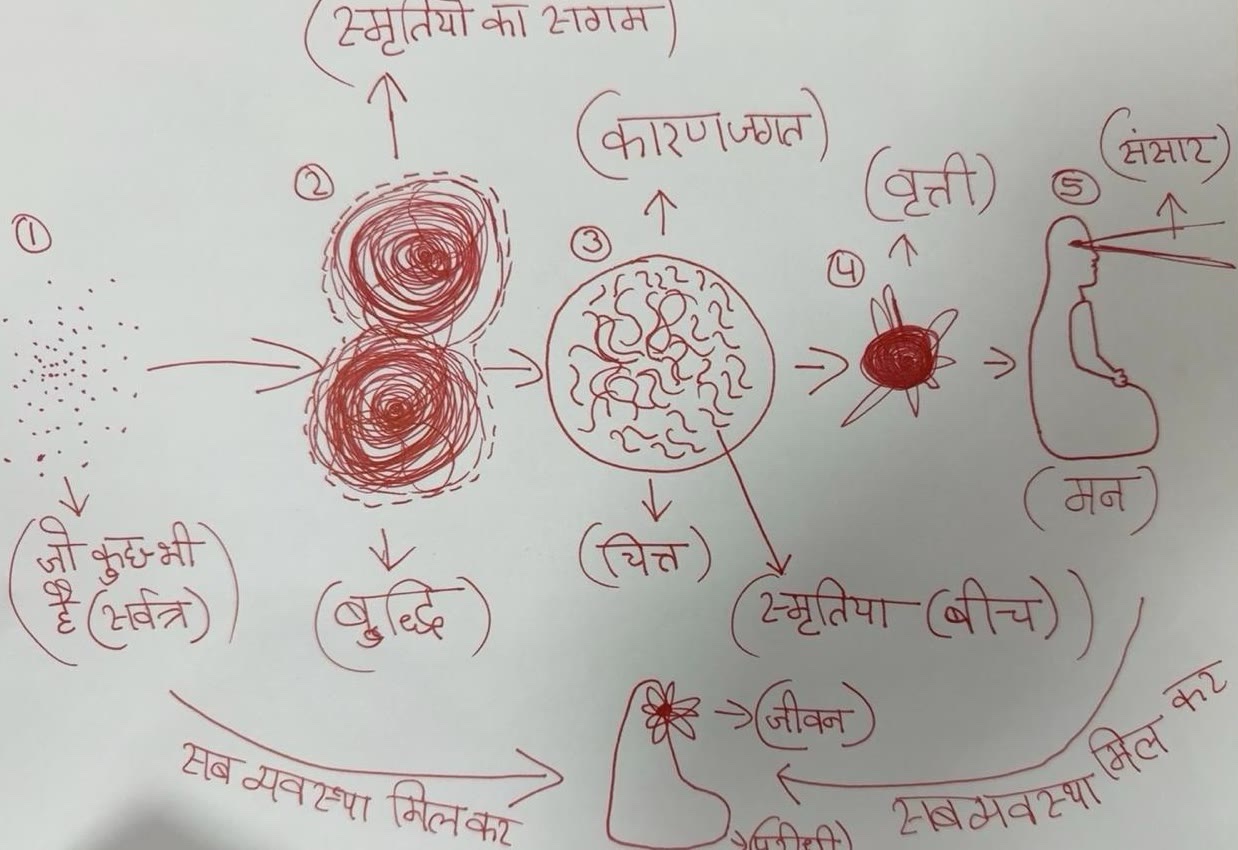
Could Gurudev explain our mind and our perception of the world in greater depth, in the way he touched on it during our last visit to the ashram. I am attaching an image to it, which Gurudev will see in a moment. That image was created during our discussion, and the question is essentially about the relationship between our perception, between our senses and the impressions we have through our senses, our capacity for discernment, and at the same time in connection with memories. And how all of this together forms our experience.
“All right, I will present this to Gurudev. And since the question relates to the image that Gurudev provided at that time, I will first forward that image to Gurudev.”
So Jan’s question is: could Gurudev explain in greater depth our mind and our experiencing of the world, as he briefly explained during our visit to the ashram? This image arose during that discussion. The question is what, in the end, is the relationship between the impressions received through the senses, the capacity to discern and evaluate, their connection with memory, and how all of this together forms itself into our experience — anubhūti? “All right. Look, here is how it is. You used the word anubhūti here — experience, inner experience. You wrote: ‘our anubhūti in relation to the world.’ But anubhūti in relation to the world is an inner matter.” “And manas — the mind — is a matter of the outer world.”
“The mind does not draw pleasure from within. The mind draws enjoyment from without.” “That is why anubhūti can never arise through the mind.” Whenever anubhūti arises, then, whenever something comes and bodha arises — awareness, knowledge —, then any such bodha arises through buddhi — discerning intelligence.” “The mind will also be included in that.” “The mind has not been removed from it. But what is most important to understand here is the role of our memories.” “We have within us an enormous storehouse of memories. Buddhi searches within them and performs calculations — similar to AI.” “AI has memories.” “You ask it some question, and from those memories it has available…” “…it performs a calculation and gives you an answer.” “And this is how anubhūti arises.” “So the mind can become entangled in the world, can be carried away by worldliness, but the mind itself does not experience anubhūti.” “It does not experience it.” “The mind does not experience anubhūti.”
So the topic of anubhūti is a bit different. It is connected with the ātman. The whole of life is connected with these five: ātman, buddhi, chitta, vritti, and manas. When all five of these together experience something in the material world, that is anubhūti. “So as for the mind, as Jan asked — if you truly begin to experience anubhūti, the mind disappears.” “The mind becomes a servant.” “Yes. It disconnects.” “Water in a pond ripples like this. What do you understand from that?”
“This moving back and forth — that is the mind. And now the water has stopped moving, has become completely calm, motionless. Now there is life in it.” “Now you can understand. Now it will experience anubhūti.” “That over there takes you away from anubhūti.” “That is why the mind has no direct connection with experiencing anubhūti.”
The ten activities of a human being and the path to complete knowledge
“And what is the relationship between all the impressions gained through the senses, the ability to discern and evaluate, their connection with memories, and how all of this together forms into our experience?” “That is exactly the point. Whatever experience you have — whether it relates to information or to knowledge — in that…” [A brief interruption follows because someone is joining the call.]
“So it was said: impressions gained through the senses.” “All the impressions that we feel through the senses proceed through four and a half activities.” “The whole of life is not involved in them, because these are different things. The domain of knowledge is one thing, jñānendriyas — the sense organs of knowledge — are something else, and our karmendriyas — the organs of action — are yet another thing. As far as impressions are concerned, our jñānendriyas remain turned outward. The karmendriyas have a greater influence here.”
“In impressions, the mind is fully present: āsvādana — tasting or savoring — and cayana — selecting. The selection takes place on the basis of what we have tasted or experienced.” “We chose based on our experience: ‘This person treated me well. He is a good person. Let’s keep him with us.’ So we chose him. We chose him based on what we experienced. Or sometimes we ate something and it was very good, from a particular shop.” “Now we already have inside us an experience of its taste. And whenever we want to eat something like that again, we order it from the same shop. We choose based on our experience.” “So in any area of life we carry out āsvādana — tasting or savoring — and cayana — selecting. That is the work of the mind. That belongs to the domain of sensory impressions. Then comes your chitta. Vritti also comes in, but vritti is primary. In chitta, two of our activities then take place: chitraṇa — creating an image, imagining — and chintana — thinking, deliberating.” “Chintana means thinking and considering on the basis of what actually is and what it is like.” “Chitraṇa means forming an idea, using imagination. For example, we have built a house and now we think: ‘What color shall we paint it?’ And all those colors begin to form within our imagination. ‘Would white be good? Or would beige be better? Or a light color? Or red for the children’s room?’ This is how we imagined it — we created an inner image.”
“What we constantly think about is in our chitta. And all of it is based on memories, isn’t it? We have already seen red, yellow, blue at some point and have them in memory. On this basis we then decide about the color of a room, our clothing, or anything else. So this chitraṇa of ours — creating an inner image — and chintana — thinking — take place in chitta. And when we spoke of four activities, these were the four activities.” “Now let us move on to vritti. When you move to vritti… Please… excuse me. As for your chitta, from chitta we took one activity — chitraṇa, imagination. We added one part from chitta to these four and a half activities. We will now set chintana aside, because it will belong among the five and a half activities.” “So you took one part from chitta and two parts from the mind.”
“From chitta you took imagination — chitraṇa — from the causal body.” “And now comes your vritti.” “It lies between the mind and chitta. Two, eight, eight — like when we create the orbits of an atom.” “Here is eighteen. The whole experience has gathered, its essence has arisen.” “So in this arrangement, two–eight–eighteen, and now thirty-two, is the atom of life; eighteen is a part of it.” “Eighteen is a part of it. One activity was called vishleshaṇa — analysis — and the other activity was called tulanā — comparison.” “These two activities belong to your vritti.” “Selecting — that we have already taken. As we said, you analyze everything. From vritti, then, came vishleshaṇa, and now you have four activities.” “Where will the remaining part come from? What remains for us is tulanā — comparison. When we compare something, we always compare it on the basis of some measure. Either we do it on the basis of nyāya, dharma, and satya — justice, righteousness, and truth; with regard to the welfare of all, of humanity, of all people, of the whole creation, of sattva, or of what is beneficial and wholesome. Or we do it with regard to what is dear to us, what is beneficial to us, and what brings profit or gain.”
“This is called comparing on the basis of priya–hita–lābha — what is dear to us, beneficial, and brings profit or gain. The other possibility is to compare on the basis of nyāya, dharma, and satya.” “And of tulanā, one half falls to priya–hita–lābha. That connects with sensory impressions.” “So these four and a half activities together form what we call saṃvedanā — sensory perception and feeling.” “And the remaining five and a half activities…” “But as for those four and a half activities, it does not mean they are useless, that sensory impressions are useless. Not at all. They are certainly not useless. We heat iron until it is red-hot and then plunge it into water — and it hardens.” “Then we heat it red-hot again and plunge it in again — and it hardens again. And it becomes stronger. The same is true of the remaining five and a half activities.”
“So what remains for us? At this moment we are still below the level of dhyāna-sādhanā. For now we live at the level of the mind, and that is why we have four and a half activities. Once we live at the level of the ātman, all ten activities will be present — these five and a half plus the four and a half. What remains in the five and a half? What remains is the ātman, your buddhi remains, and one part of chitta remains — chintana.” “And of vritti, that half of comparison remains, which we spoke of — nyāya, dharma, and satya. Half, that is, half of the comparison.” “This half of comparison thus means living on the basis of nyāya, dharma, and satya — justice, righteousness, and truth. Then one part of chitta remains, which we call chintana.” “And then two parts of buddhi remain — two activities. One activity is called bodha — comprehension or knowing, the other is called saṅkalpa — firm intention or resolve.” “So… chitta… means a saṅkalpa filled with truth.” “As soon as bodha arises, saṅkalpa also arises: ‘This is exactly what I will do.’”
“So you are left with half of one activity from tulanā — comparison. That is one and a half. And to that, two activities of buddhi — saṅkalpa and bodha. Together that is three and a half. And then two activities of your ātman.” “The ātman, although inactive, is at the same time active. It is the basis of all activities.” “In the ātman, then, two activities take place: anubhava — experience, direct perceiving or knowing — and, on the basis of that experience, pramāṇa — confirmation, verification. So two activities: anubhava and pramāṇa. When experience arose, the matter was thereby confirmed.” “So that makes the five and a half activities.” “This is called saṃjñāna or saṃjñānitā — cognition, knowing.”
“But a person who lives in all ten activities is a yogi.” “Yes, that is a yogi. That is a yogi, that is Yogeshvara.” “And one who lives in the five and a half is a tyāgī — one who renounces. One who lives in the four and a half is a bhogī — one who lives in enjoyment or experiencing.” “If he lives in all ten activities…” “…then he makes proper use of everything — sadupayoga.” “That is Yogeshvara.” “That is why neither mere renunciation — tyāga — nor mere enjoyment — bhoga — is correct.” “We follow the path of the yogis — we make proper use of what exists.” “So as for these ten activities, Jan presented this very beautifully today.” “Before, the question was incomplete and the answer was incomplete. Now the answer is complete too. So I think that, on this basis, Jan’s question and answer have now been properly completed.” “As for how we ought to live: we should not abandon the four and a half activities and live only in the five and a half.” “We should not take off our clothes, throw them away, and live naked.”
“We should wear as much clothing as we need. That’s all. I use and properly make use of as much as I need.” “And whatever remains beyond that, I use in my relationships.” “I use it for my loved ones, my companions, my friends, my family. What remains, I share among them.” “So we want to live in all ten activities. And only a person who lives in all ten activities is truly mānava — a human being.” “That is a human being. That is precisely a human being. Four and a half is a problem. Five and a half is, in its own way, also a problem — the bhogī on one side and the tyāgī on the other. Neither through renunciation did anyone reach the proper place, nor through enjoyment did anyone reach the proper place. The one who reached it was the one who made proper use of everything — sadupayoga.” “And who, without hesitation, without fear, and fearlessly, made full and proper use of everything. Yes, I use it.” “I need it.” “I will travel by helicopter. I will fly in a private plane. I will use all these things. I will also travel by ox-cart. I will also ride a bicycle. Wherever I need to go, I will use whatever is needed for it.” “I will use it with this awareness. That is neither tyāga — renunciation — nor bhoga — enjoyment.”
“When I say to myself: ‘I will take it at any cost, whatever happens,’ then that is clinging to what I want.” “And a person gets stuck in that. So, where a needle is needed, the needle will do its work, and where a sword is needed, the sword will do its work.” “Each of them has a different role, but the result is the same — it is favorable.” “That is why humanity means living in ten activities. It is human nature to live in all ten activities.” “Very good. Once you have the translation ready, you may ask follow-up questions if you have any. But this answer is now complete and brings you to an understanding of the four and a half and the five and a half. And once you understand this, you will go neither only the way of the four and a half, nor only the way of the five and a half. You must have all ten. Once you have the translation, it will be even clearer to you. If any further question arises from this answer, you may ask it next time or prepare it accordingly. Yes. Please, the next question. Can we?” “We will study everything thoroughly and understand it. And if any doubt remains…”
It can actually be expressed in a single sentence: “When we live within the four and a half activities, it is about saṃvedanā and bhoga. When we live within the five and a half activities, it is about saṃjñāna or saṃjñānitā and tyāga. When we live in all ten activities, it is about mānavīyatā — humanity and wholeness — and sadupayoga, that is, the proper use of what exists.”
Sacred places, dreams, and the influence of memory traces
“Yes, Jiří, please, the next question.” “A question from Květa: This week I visited the reliquary of Saint Maurus, an important Romanesque monument, where the relics of Saint John the Baptist and Saint Maurus are kept. I did not know about this in advance; I was given tickets. In his presence I felt a very strong energy, but it was not negative. Nevertheless, I afterward asked the Darbar for purification. At night I saw myself in the ashram. I moved among the regular visitors as if I belonged among them. In the past I also visited the Holy Sepulchre in Jerusalem. I have two questions: Is it a mistake to visit such places, even though they are considered sacred? And second: I repeatedly dream about the ashram and sometimes see myself there. Does this carry any particular informative meaning for me? For example, some kind of warning or sign that I am doing something wrong?”
“All right. I have understood her question. She says that just this week she visited a place connected with Saint Maurus. She went there for darshan, and his tomb or shrine is located there, where some of his remains are kept…” “Some sacred relics of Saint John the Baptist and Saint Maurus are also kept there. Relics mean that their smṛti — memory traces — are preserved there. She did not know in advance that anything like that was there. When she arrived, she felt an energy and it seemed positive to her. It was not negative — she wrote that she felt nothing negative, that is how she perceived it. Nevertheless she then asked the Darbar for her own purification. That night she saw herself in the ashram. She moved there among people who come there regularly. She had the feeling as if she were moving among the regular visitors, and as if she herself were one of them. That is how she felt it. And she had previously also visited, in Jerusalem, the sacred tomb of Jesus Christ and had darshan there. So this is good. There is no doubt that not everyone is negative. However, it is necessary to recognize what degree of positivity they have. For someone, something may not be negative, but for someone else it may be negative. For someone it may be positive, while for another it may not be. It depends on their own understanding and on how that person lived during their life. Their memory traces will act accordingly. Whoever it is, to whatever dharma, faith, or religion they belong, whether they are a saint, an ordinary person, or a politician — whoever that saint may be — their memory traces remain active. And they act in the same way that this person lived their life. So if their remains persist, they will radiate the same influence. You say, for example, that it did not seem negative to you. That is also connected with your own belief. According to what belief you hold and what memories you have, that is also how you felt it. And there is also a theory — and it is a correct scientific theory — that according to how you form a memory, that is also how you then feel something. But around you are the protective shields of the Darbar. No outside energy can enter you unless you have moha — attachment — toward it. The entry gate remains closed and energy cannot enter. Only through your attachment, your connection with it, or through prayer can this energy enter you. So it is good that you went there, that you liked it there, and they are all saints. There is nothing wrong even in visiting saints. So you did the right thing. You did nothing wrong. And the best thing you did was that you prayed to the Darbar. It is similar to saying: one person may be good, but ten others go along with him — and all ten of them need not be like him. So they can influence you in various ways, including negative ones. But through this, all such influences were removed from you. You went there in purity and returned in purity as well. Everything is fine.”
“A person eventually recognizes it. You yourself will recognize it.” “Isn’t that so? So there is no problem in that. It is good.” Next question.” “The question was: Is it wrong to visit such places, even though they are considered sacred?” “You know, this is on the level of mānyatā — belief, what a person considers to be true or correct. People naturally go where they are convinced it is right. You naturally go where you consider it right. Just as you consider the Darbar to be right, so you come here. So a person naturally goes where he considers it right. But pramāṇa — confirmation — you get through anubhava, your own experience. When you go there, then, on the basis of your experience, you say: ‘What feelings come from here? What do I feel here? How do I feel here?’ And by this you recognize the difference.” “And sometimes she dreams about the ashram. Sometimes in a dream she sees herself here in the ashram. And she asks whether this carries for her any special message — for example some kind of warning or sign that she is doing something wrong.” “That is not the case at all. Not at all. It is a very good sign. What you have in your thoughts and what you think about also appears in your dreams. And that feeling within you: ‘Am I not perhaps doing something wrong?’ — that is precisely what makes you devoted to the Darbar and keeps you watchful and attentive — sajag.
Precisely your watchfulness and attentiveness are your simplicity and sincerity. So, definitely not. It is completely fine. There is nothing negative in it; everything is good. It is not any kind of warning. It is a sign that you are close to the Darbar.”
Emotional instability and concentration in sādhanā
The next question is from P. P.’s question is that he would appreciate it if Gurudev could help guide him, help him, because he feels he has within him a certain degree of emotional instability, which prevents him from full concentration during his sādhana and also in other activities. How can he achieve full concentration?
“I already analyzed this in the answer to the previous question: to live on the basis of saṃvedanā, to live on the basis of saṃjñānitā, and to live on the basis of humanity — mānavīyatā. When drashtā bhāva — the state of the observer — grows stronger in you, your life becomes simple and stable. But as soon as you begin to live on one side or the other — either in tyāga, renunciation, or in bhoga, enjoyment — instability arises. When you live in renunciation, you will be attracted to enjoyment. And when you gradually begin to live in enjoyment, you will begin to be attracted to renunciation. In this way a person swings, birth after birth, like on a swing: first renunciation, then enjoyment, then renunciation, then enjoyment…” It must be like a scale. When you grasp it in the middle, balance arises — samyak. Some mahāpurushas used the word samyak. It is precisely this samyak that you need — you must move toward sadupayoga, proper use. Your imbalance, your instability arises because your pendulum swings once toward renunciation and once toward enjoyment. First tyāga, then bhoga, then bhoga, then tyāga. It keeps swinging back and forth. That is all.” “And ekāgratā — concentration — comes when both pans of the scale stop moving up and down. When you grasp the scale in the middle, at the point of balance, both pans become level, come to rest, and become stable. That is the place of sadupayoga — proper use. One pan of the scale represents bhoga — enjoyment, the other represents tyāga — renunciation.” “So, Mr. P., are you satisfied with the answer?” “Good. Shall we move on to the next question then?”
Kumbhaka, hernia, and sankalpa
Question no. 7 — F. F.
F. F. has an older, already operated hernia, and next to it a new, fresh hernia. He is asking, then, whether he can practice kumbhaka. One more addition to the question: that abdominal hernia is located in the area of the navel.
“There are seven kinds of hernia. But now there is no hernia there. In the intestines there remains only a bit of swelling. At present, then, because of this swelling in the intestines, he does not have a hernia. He asked whether he can practice kumbhaka with a hernia, and if not, whether there is some alternative practice. Firstly, as I said, he does not have a hernia now. Secondly, if you have swelling in the abdominal area, you must avoid that kind of exercise. You should not do this exercise now. You can perform a simple prāṇāyāma, which we can call anuloma-viloma. You can also hold the breath in kumbhaka and then release it very calmly and slowly. That means in such a way that no pressure or shocks arise there. Right now, do not try to do anything that would cause jolts in the navel area. At this moment you must avoid shocks in that area. You do not have with you a substance for lepan — a poultice/applying a healing layer, but if you were to use lepan there, the swelling would also disappear. There would be no problem. Someone among his ancestors in the family once had a very strong prostate infection.”
“There was a prostate infection there, a very strong infection. There are its smṛti — memory traces — there, and even those are all now leaving. You also asked about the manipūra chakra, whether this could have any negative effect on its functioning, and how to bring it back to normal. So first understand that you do not have a hernia. All right? So there is no reason for concern. Digestion is improving. The only thing to keep in mind is that a clay poultice — mittī kā lepan — could help there. Prepare the clay well, and you can make a poultice from it for him for 30 to 35 minutes, completely from the pelvic area up to the navel. The clay’s job is to absorb. And it can do this very well. And now for the main problem he had… Close your eyes for a moment. At the same time we will do a bit of work.” “F., please, close your eyes.” “Focus on Baba and Mā.” “Pray to Baba and Mā.” “His vāyu circuit and prāṇa circuit, which had been reversed, have now been corrected. The swelling has been removed. Everything is fresh. Digestion is not in order. There is also constipation there. Say three times: Om Namah Shivāya.” “Three times Om Namah Shivāya.” “Say three times: Om Namo Nārāyan.” “Three times Om Namo Nārāyan.” “Then open your eyes.” “And then open your eyes.” “One more thing regarding sankalpa: he is probably not doing his sankalpa correctly.” “F., Gurudev is asking whether it is possible that you are not doing your sankalpa correctly.”
“His net-like layer has not yet been broken through, do you understand? There is swelling there.” “Look. It is something like a net, a fatty layer around it. He does not have a hernia. That has already disappeared. But the surrounding fatty layer remains. And that too would leave through lepan and through the sankalpa, which F. is probably not doing correctly.” “He says that you have a large fatty layer there, which will disappear if you use lepan — that is, the clay poultice. And Gurudev says he thinks you are not doing your sankalpa correctly, and you should answer that.”
“I do sankalpa according to my own conviction, the way I am supposed to practice it.” “Mr. F. F. says he is convinced that he does sankalpa the way it should be done.” “I say that he is making a mistake. Because I don’t know whether he is aware of it or not, but there was contraction occurring in the rectal area.” “You don’t know about it, but your rectal area was actually contracting.” “There was a wound inside, which [unclear part of the transcript]…” “A wound formed inside, which the Darbar is now cleansing.” “You had problems with your eyes, tension, and your liver isn’t quite in order either.” “You have or had a problem with your eyes, you have tension at the crown of your head, and you have a problem with your liver.” “Once again, please, close your eyes.”
“Close your eyes.” “And say a long: Om. And everything we have just discussed, this entire discussion… let everyone form a sankalpa from it.” “Focus on your grandparents on your father’s side, on your grandparents on your mother’s side, and on your parents.” “Just recall your grandparents.”
“Recall your grandparents, your grandfather and grandmother, and also your mother and father.” “Now turn your attention to yourself.” “Say three times Om Namah Shivāya and then open your eyes.” “Om Namah Shivāya. Om Namah Shivāya. Om Namah Shivāya.” “Open your eyes.” “Gurudev has now left for 10–15 minutes. He has to resolve something urgent and will be back in ten to fifteen minutes.” Also, Dr. Ž.’s question will be answered once Gurudev returns.” “Does this discussion bring you joy? Are you enjoying it?” “And from this understand one thing: understanding, understanding, and understanding again. Compare for yourselves at what level of understanding you currently stand. Not for the sake of competing, but for the sake of inspiration — that we must fully understand everything and, through ever deeper and deeper understanding, continue onward. Today’s discussion went deep. The topic was interesting and opened up many secrets. And it is precisely such discussions and precisely such questions that should naturally arise within each of you. The deeper your chintana and manana — thinking, contemplation, and deep reflection — the higher…”
“Know with certainty that you will have to pass through all these levels: liberation from the karmendriyas and dwelling in the jñānendriyas; liberation from the jñānendriyas and dwelling in the state of prāṇa, in the state of vijñāna, and in the state of ānanda. You will have to pass through all these levels. And the path is very simple: try to truly and thoroughly understand every word of Gurudev. Something may be expressed in words very simply and naturally. But if you contemplate it deeply, you will find that it is not merely an explanation that can be expressed in a few lines. It is an explanation that reveals many secrets. It is precisely these secrets, which we have discussed today and until now, that will reveal to you the secret of creation, reveal the secret of māyā, distance you from illusion, and allow you to understand things with great precision and clear analysis. A person usually gets nowhere at the level of understanding, because he lives in mānyatās — adopted beliefs and notions. And when a person lives in these beliefs, they at the same time become his boundary. That is why on many occasions there have already been situations and opportunities in which you have been very emphatically guided in this direction:”
“Become independent. Become free. Free yourselves from adopted beliefs and head toward satya — the Truth that never changes. The greater the lagan and agan within you — devotion, inner ardor and fire — the greater the speed you will gradually gain. At this moment we are limited by time and Gurudev has his duties, so questions are being selected very selectively. But in the future a period will also come when your questions will arise naturally from your own path. And when you then present them, things will begin to show themselves to you in a very correct and clear way. Then, accordingly, you will be able to proceed toward your highest goal. Always remember this. And now I would like to ask all of you for something. One of the main components of sādhanā — and in fact the most important one, when we listen to Gurudev or to the speech of the mahāpurushas — is shravaṇa, listening. Shravaṇa means that you have heard through the ears. If you have truly listened correctly, it means that work has begun on your Vishuddhi chakra, because the ear is the jñānendriya — organ of knowledge — of the Vishuddhi chakra, and the throat is its karmendriya — organ of action. That is why shravaṇa — true and attentive listening — is extremely important. This cannot be achieved otherwise — you achieve it through listening. And immediately after listening comes the next activity, which is manana — contemplation, deep reflection. That means you now begin to think about it. And where does this chintana — thinking, contemplation — take place? Gurudev has just explained this: chintana takes place in your chitta, in the causal sphere — kāraṇa jagat. Chintana and chitraṇa — contemplation and creating an inner image.”
“In this way you gradually open up the path all the way to your causal body — kāraṇa sharīra. And finally I will say only this: understanding, understanding, understanding, and understanding again. There is no other path. All right? Now I would ask all of you: Gurudev has so far given explanations to a whole series of questions and answers. You have already heard all these explanations, but it is possible that you have meanwhile forgotten some things. So now, after you have listened attentively to all of this, all of you close your eyes and contemplate it continuously until Gurudev returns.”
Ventricular arrhythmia and health condition
“Doctor Ž., you can turn on your microphone.” May I ask you, please, for healing? I have a question. For the past three weeks I have had ventricular arrhythmia and I am not able to do anything at all, not even meditate. It is very unpleasant. That arrhythmia is very strong. Within 24 hours I had 20,000 ventricular arrhythmias. If you can help me, please.
“Gurudev is asking, what area of medicine do you specialize in? What diseases?” “Doctor Ž., Gurudev wants to know what field or specialization you have in your medical practice.”
“Even though you are a general practitioner, do you have some area you specialize in more, or lean toward more?” “I have no particular specialization.” “No.” “You can speak openly. Look. Your kidney is shrinking. The ureter, that tube, is swollen, and you also have a urinary tract infection.” “You have a problem with your kidneys too, you have a problem with the ureter leading from the kidney, and you also have inflammation.” “You feel great heat, you truly feel very hot. Certain energies from the Darbar were providing you protection, so that a collapse due to cardiac arrest would not occur. That is why you may have felt greater heat inside your body.” “Yes, in recent days I have been feeling great heat.” “Yes. That is what the Darbar is providing you. That is what Gurudev is providing you. Now look at your heart. There is swelling on the heart — this memory trace — and there was also swelling on the heart valve, which was causing you very intense difficulties. The cholesterol level… the blood was becoming thicker. The oxygen level in the blood was dropping rapidly; there was a lack of O₂ in the blood.”
“In fact you were already being treated. That is why you felt unpleasant, and as a result of this treatment you felt such great heat. You were protected from the energy and the memory trace that was prepared to attack you and cause cardiac arrest. So the Darbar was treating you in order to protect you from heart failure.” “And meanwhile you were taking certain medications. Because of them your blood thickened, and as a result certain problems appeared.” “Out of fear because of the current illness you began taking certain medications. According to Gurudev, these caused an increase in the thickness of your blood and a rapid rise in your cholesterol level.” “Yes, I have very high cholesterol.” “Yes, it was very, very high.” All right? Is that so?” “That is completely correct, Gurudev.” “So treatment is underway; it is not that you are only now becoming ill.” “Yes. In fact it is treatment. It is not that you are only now becoming a patient. You are already a patient, but the Darbar has been treating you. You perceived it as a worsening problem, but in fact, according to Gurudev, it was part of…” “And sometimes at night you had the feeling that your breathing was getting worse, as if you were suffocating. And sometimes you probably felt or had the worry: ‘What if I have a heart attack?’” “At night you had problems, as if something were gripping you, as if your heart were being squeezed and you couldn’t breathe. And you were afraid you might collapse or die.”
“But in fact that is not the case.” “You will be completely fine.” “And you will feel much better and will be completely fine.” “Thank you.” “All right, Rajeev ji, shall we continue?” “Yes, Gurudev.” “Doctor, you will be completely fine again. Don’t worry. The treatment has already begun for you. It began already at the time you sent it. Just to inform Gurudev, I accidentally also sent him your medical report. Gurudev laughed at that and said that the Darbar does not need your medical report. It has its own way and system of diagnosis.” “All right, Jiří, let’s move on to the next question.” “Yes.”
Pain in the left hip joint and memory traces
Next is question number eight, actually nine.
He has a sharp, stabbing pain and limited mobility in the left hip joint. After meditation it always improves. At his first meeting with Gurudev, Gurudev treated him and the symptoms disappeared for several months, but then slowly began to return.
“These illnesses and difficulties are for the most part mental and to a lesser extent physical. So what mistake did he make, that these difficulties returned again? Or is the illness precisely now leaving him? What does he himself feel?” “This is very important. When the problem existed the first time and was then removed, that in itself means that this memory trace disappeared. Otherwise you would not have experienced this relief. You obtained relief because, according to Gurudev, the memory trace disappeared. But you must really think deeply about what mistake you are making, that the problem is returning again.”
“We make certain mistakes, and through these mistakes we actually revive our memory traces again. And so we return to the same point from which we originally set out.” “Have you never tried to find out where these difficulties come from? Where do these memory traces that are traveling to you come from?” “You have never tried to explore where this memory trace actually comes from.” “If he went for a medical examination, he would find that everything is fine with him. So why does he still feel the difficulties?” “If you go for a medical examination, you will find that the part of the body that is causing you difficulties is in fact fine. Then the question arises: if everything is fine, where are these difficulties coming from?” “And if there really is a physical problem there, why does it then adjust itself again and again after dhyāna sādhanā?”
“If that is the case, then how is it possible that your condition improves after dhyāna sādhanā, after meditation, and after your practices?”
“From this it follows that these difficulties are not his own.” “So according to Gurudev, this in itself shows that this is in fact not your own problem.” “This problem comes from the side of his wife. And with his wife, it originates from her family of origin — from her māyke pakṣ, the side of her parental home.” “And now listen very carefully. According to Gurudev, this memory trace is being transmitted through your wife K. But it does not arise directly from K. herself either — it comes from her family lineage and through her is ultimately transmitted to you.” “And the person from her family of origin who suffers from these difficulties does not, in fact, have a problem only in the hip. He has difficulties throughout that part of the body. But with him it manifests only in the hip.” “The person from your wife K.’s family lineage in fact has, according to Gurudev, a problem in the entire left side of the body, whereas you feel this pain only in that specific place — in the hip area.”
“These difficulties come from his wife’s family. But even so they do not actually enter him. They remain outside his protective shield — kavach. That is why he has the feeling that he has some illness or pain, even though, according to Gurudev, it is not actually a real illness.” “So when this memory trace comes from K.’s family, it affects you, but it does not affect you in the sense that it would actually enter inside you. It cannot enter you. But it produces in you the feeling as if you had pain. In fact, according to Gurudev, it is not causing you this pain; a feeling arises that something hurts. And you accept this feeling as real pain. And by this, the perception of pain is then intensified.”
“These memory traces keep moving around in circles…”
[A brief digression follows, in which Gurudev gives instructions to someone in the room.]
Then he returns to the topic: “So, Rajeev bhai, that’s how it is, and the cause of this reaches quite deep.” “For example, her family was once connected with a certain place and with a certain religious person. This religious person suffered from all these difficulties. And because of attachment to him, after his death these difficulties were transmitted into her family of origin. Through the action of this energy and this memory trace, a deficiency of blood arises [probably anemia or a reduction of some blood component is meant], weakness arises in the body, and [the last Hindi term is unclear in the transcript] also weaken.”
“And also skin diseases, blood infection, and anemia. This energy, according to Gurudev, acted as if it were taking blood from you and causing anemia.” “So this is precisely where this energy comes from, and that is precisely the origin of your difficulties. And it also contributed to the emergence of an infection in the area of the reproductive organs.” “So all these difficulties were someone else’s difficulties. And now, if…” “Close your eyes.” “With your eyes closed, focus on your wife.” “And picture your wife K.”
“Close your eyes and in your mind look at your wife K.” “Say three times Om Namah Shivāya and then open your eyes.” “Now check yourself, P.” “Check whether you are all right, feeling well.” “Yes, P., you can turn on your microphone and tell us.” “Yes, I felt relief.”
“After walking he feels relief.” “Check your strength. P., stand up, do a few squats. Check whether you have energy and strength.” “He feels good. He feels strong.” “Now please take K.’s hand.” “K. is standing to your left. So K. will give you her right hand, and you will take it with your left hand.”
“Close your eyes.” “Recall the time of your wedding. Recall your wedding ceremony.” “Each of you focus on your parents.” “Then focus on yourselves. Feel yourselves.” “Say three times Om Namah Shivāya and then open your eyes.” “Om Namah Shivāya. Om Namah Shivāya. Om Namah Shivāya.”
“Now both of you walk around, stand up, sit down, and check everything. You are now like children, no difficulties. Back, knees — everything is new.” “Both of you walk around the room. Do a squat, down and up, and check yourselves. K. too. Check how you feel.” “I definitely feel better. There’s still a little stitch there, but relief has already come.”
“He feels considerable relief. There is still a bit of stabbing pain, but the relief is significant.” “Yes. Good. Very good. Perfect. Both of you are fine.” “So that numbness would not occur, a very light, mild pain was left there, so that perception would remain preserved.” “Gurudev always leaves a very mild pain, so that the given place does not become numb. If the pain were removed completely, according to him it would cause numbness in that area. That is why only a slight stabbing pain is left, so that the area remains active and does not lose sensitivity.”
Individual and universal consciousness
“Is there a difference between individual consciousness and some overall consciousness that dwells within us? And where does individuality actually come from?” “This question is mine.” “Oh, is it yours? All right, then I don’t need to switch you to the picture separately. Go ahead.” Sensei translates the question: “Is there a difference between consciousness and the individual consciousness that dwells within us? Where does it arise from” “Is that his question? Jiří’s question? As for consciousness…” “Or put differently: where does the consciousness or awareness of separate individuals arise from? This whole question is connected with that very first question we discussed at the beginning.” “We spoke about what it means to live consciously and to live in unconsciousness. From there the question of consciousness begins to become clear.
“But as for what you are asking — whether individual consciousness, or perhaps some individual existence, is truly a separate consciousness: consciousness is never separate. It only appears as separate.” “Because consciousness is like the ocean. If you scoop a vessel of water from the ocean, all the drops in that vessel still consist of the very same water of the ocean. There is no need to examine the whole ocean to know this. Or take a piece of gold. If you divide it into a thousand pieces, its quality does not change at all. There may be a quantitative difference, but not a qualitative difference. It is the same with consciousness. In its quality there is no change whatsoever. But when consciousness combines with your memory traces (smṛti), it causes you to experience things differently, to think about them differently. On the basis of the ten activities present in your life, which we spoke about, and on the basis of your memory traces, consciousness causes you to perceive and see things differently. In reality, however, everything is interconnected. Nothing is separate. Everything is one.” “When we are under the influence of māyā, everything appears to us as separate. When we come under the influence of Brahman, we see everything as one.” “Exactly so.” “That is precisely the point.”
“Yes. It is one single thing, it is not separate. Only the way in which it manifests may, on the basis of different memory traces, appear more or less individual or collective.” “According to what our memory traces are.” “Hmm. Ah, I understand. All right, Jiří. Perfect. Yes, that is for you. And also for everyone else. Some students have just written a question about the fact that there is one universal consciousness and then the individual consciousness we are just talking about. They too are sitting here and listening.” “It is necessary to tell them precisely this: everything is a manifestation of one Sun. Whether it manifests as an individual ray, as sunrays, or as light, all of this radiance comes from a single Sun.” “Yes.”
“So whether we speak of individual consciousness, universal consciousness, or existence, everything is one. None of it is separate. In other words, when we say: ‘God is in everyone,’ what does that actually mean? It means that one consciousness is present everywhere. Therefore nothing is truly separate, nor can it be separate. In the end everything will unite again in the One. It will return to where it came from, and will unite in it once more.” “A very beautiful question. A very good question.”
Meditation
“I think the time for sādhanā is approaching.” “It would be better if we did it now. It’s already half past twelve in India, isn’t it?”
Everyone get ready for meditation. We will meditate for 16 minutes. “16 minutes?” “Yes, Gurudev. Right now.”
“Everyone take your mudra and keep your spine straight.” “And keep a light smile on your face.” “Join the fingers of both hands in front of the navel and press your palms to the navel.” “Now all of you will slowly move upward. Begin at the navel, at the manipūra chakra, continue through the anāhata chakra, further through the Vishuddhi chakra, until you settle in your kūtastha — the ājñā chakra. Then the music will begin. Follow it.” “Everyone focus on kūtastha, the space between the eyes.” “Please, begin.” “May all of you thrive. May your families thrive too. May all of you be healthy, happy, and may you thrive and prosper.”
The Ten Activities — a complete corrected overview and glossary
Based on a conversation recorded in GMT20260920-161948_Recording.m4a on 20 September 2026. Processed 21 September 2026.
Complete corrected material. Contains an overview, an explanation of the 4½ + 5½ division, a comparison with classical terminology, and a glossary. This is a study aid, not a verbatim transcript of the conversation.
1. Five domains and ten activities. The following order corresponds to the previous overview. This is an assignment of functions within this teaching, not an anatomical location or a claim about specific brain regions.
| Domain | First activity | Second activity | Meaning in this conversation |
|---|---|---|---|
| Manas — मनस्, in Hindi man, मन | Āsvādana (आस्वादन): tasting, savoring, sensory experiencing | Cayana (चयन): selecting, choosing | Something is experienced, and on that basis we choose — an example is choosing food based on a remembered taste. |
| Chitta — citta, चित्त | Cintana (चिन्तन / चिंतन): thinking, contemplation | Chitraṇa (चित्रण): imagining, forming mental images | Thinking about what something is and what it is like; imagining possibilities using memory, for example the colors of a room. |
| Vritti — vṛtti, वृत्ति | Vishleshaṇa (विश्लेषण): analysis | Tulana / tulanā (तुलन / तुलना): comparing, assessing | According to certain criteria: preference and personal benefit, or justice, dharma, and truth. |
| Buddhi — बुद्धि | Bodha (बोध): comprehension, knowing | Saṅkalpa (संकल्प): decision, intention, resolve | Out of comprehension comes firm resolve: “This is how it is; this is what I will do.” |
| Ātman — ātman, आत्मन्, in Hindi ātmā, आत्मा | Anubhava (अनुभव): experience, direct perceiving or knowing | Pramāṇa (प्रमाण): confirmation, verification | The speaker connects experience with its confirmation; “pramāṇa” here should not automatically be understood as scientific proof. |
Five domains times two activities equals ten activities. The distinction between āsvādana at the level of manas and anubhava at the level of ātman is essential in this explanation — translating both simply as “experience” would obscure this distinction.
2. How 4½ + 5½ fits together.
| Domain | Counted in 4½ | Counted in the remaining 5½ |
|---|---|---|
| Manas | Āsvādana + cayana = 2 | — |
| Chitta | Chitraṇa = 1 | Cintana = 1 |
| Vritti | Vishleshaṇa + half of tulana = 1½ | The other half of tulana = ½ |
| Buddhi | — | Bodha + saṅkalpa = 2 |
| Ātman | — | Anubhava + pramāṇa = 2 |
| Total | 4½ | 5½ |
The first half of comparison is described using the terms priya–hita–lābha: what is pleasant or dear, what serves a certain interest or benefit, and what brings profit. The second half is described using the terms nyāya–dharma–satya: justice, dharma, and truth. “Half” is part of the explanatory scheme, not a precisely measured division of a psychic faculty. The earlier formulation narrowed priya–hita–lābha too much to “people close to me.” The speaker does give family and friends as examples, but the terms themselves also include preference, benefit, and gain.
Note on an inconsistency in the text: the original transcript explicitly places imagining in the 4½ and reserves contemplation for the 5½. The new speech recognition captures cintana in the recap around 1:19:25–1:19:35. However, a second recognition model also captures chitraṇa in a later recap around 1:19:49–1:20:07. This may be a slip of the tongue or a recognition error; it cannot simply be attributed to an old translation. The overview above is an editorially unified summary based on the explicit distinction and on the total count of activities. It should not be presented as though every repetition in the recording is entirely identical.
| Scope | Principle | Way of living |
|---|---|---|
| 4½ | saṃvedanā | bhoga — sensory feeling and enjoyment; a life in which one’s own needs and preferences are in the foreground. |
| 5½ | saṃjñāna / saṃjñānitā | tyāga — cognition or awareness, which the speaker connects with renunciation and a broader focus of life. |
| 4½ + 5½ = 10 | mānavīyatā → wholeness | sadupayoga — humanity, or full human living, which is expressed through proper use. |
These connections reflect the speaker’s explanation and are not universal dictionary definitions of these terms.
The goal is not to discard the first 4½ activities and live only through the remaining 5½. The speaker recommends living through all ten. He calls such a person a yogi and emphasizes sadupayoga — proper, beneficial use. The practical meaning is explained by his examples: wear the clothing that is needed; use what is necessary and share what remains; use a needle where a needle is needed, and a sword where a sword is needed; depending on the task and circumstances, choose a helicopter, a private plane, an ox-cart, or a bicycle. The emphasis is on proper use, not on attachment exclusively to enjoyment or exclusively to renunciation.
The earlier scheme placed samyak between bhoga and tyāga as proper and balanced use between enjoyment and renunciation — this should be understood as an illustrative interpretation. Samyak means correctly, properly, or fully; “the middle between enjoyment and renunciation” is not its only literal meaning. The precise use of this word elsewhere in the recording was not independently verified from the audio during this review.
3. Comparison with classical yoga and Vedānta. The scheme of ten activities should be distinguished from the common fourfold Vedāntic description of the antaḥkaraṇa — the “inner instrument”.
Manas — attending to information and weighing it, considering alternatives or doubting.
Buddhi — discerning, understanding, and deciding.
Ahaṃkāra — the sense of “I,” identifying with experience as something “mine”.
Chitta — memory and recollection; in some descriptions contemplation.
These are functional aspects of the inner instrument, not necessarily four separate organs. Terminology differs between traditions. In particular, chitta has a broader meaning in Patanjali’s yoga than mere “memory.” Swami Sivananda: Chitta and Memory
In Patanjali’s yoga, vritti denotes the activities or modifications of chitta. The five kinds given in Yoga Sutra 1.6 are pramāṇa, viparyaya, vikalpa, nidrā, and smṛti: valid cognition, misconception, conceptual construction, sleep, and memory. This is a different division from the five domains with two activities each. Yoga Sutras 1.2 and 1.5–1.7
The earlier overview correctly distinguished the individual systems, but too quickly labeled the tenfold model as the speaker’s personal invention. A more precise description reads: “The ten-activities model as taught by Gurudev, with a close documented parallel in Madhyasth Darshan / Jeevan Vidya.”
4. Glossary. The following definitions translate and clarify terms used in the previous overview. Meanings specific to this conversation are marked as such. Inclusion of a term does not mean every occurrence of it in the full three-hour recording was independently verified.
| Term | Devanāgarī | Meaning and context note |
|---|---|---|
| Ātman (in Hindi ātmā) | आत्मन् / आत्मा | Self; in this conversation connected with anubhava and pramāṇa. |
| Anubhava | अनुभव | experience, direct perceiving or knowing. |
| Anubhūti | अनुभूति | experience or inner experience/perception, related in meaning to anubhava; a more precise distinction depends on how the speaker uses the terms. |
| Pramāṇa | प्रमाण | proof, confirmation, or means of valid cognition; here the speaker connects it with confirming experience. |
| Manas (in Hindi man) | मनस् / मन | mind, in this model the domain of āsvādana and cayana. |
| Āsvādana | आस्वादन | tasting, savoring, appreciating through experiencing; the missing Hindi counterpart of the earlier “testing.” |
| Cayana | चयन | selection, choosing. |
| Buddhi | बुद्धि | understanding or discerning intelligence, connected with bodha and saṅkalpa. |
| Bodha | बोध | comprehension, awareness, knowing. |
| Saṅkalpa | संकल्प | intention, resolve, firm decision. |
| Ṛtambharā (probable reading) | ऋतम्भरा | bearing truth, or filled with truth; probably lies behind a damaged sentence in the explanation of sankalpa — the new transcript captures a similar sound and then “intention filled with truth,” this reading remains provisional and no further claim about Brahman or chitta should be drawn from the damaged sentence. |
| Vikalpa | विकल्प | alternative or conceptual construction; in Yoga Sutra 1.9 it has a specific technical meaning, “doubt” alone does not capture it there. |
| Chitta | चित्त | mind or mental field, with varying breadth of meaning across traditions, here connected with cintana and chitraṇa. |
| Cintana | चिन्तन / चिंतन | thinking, contemplation, deep reflection. |
| Chitraṇa | चित्रण | depicting, imagining, creating a mental image. |
| Vritti | activity, mode, or modification; in this model the domain of analysis and comparison, this assignment differs from Patanjali’s classification. | |
| Vishleshaṇa | analysis, analytical breakdown; previously the unclear “mislešan.” | |
| Tulana / tulanā | तुलन / तुलना | comparison, assessment. |
| Priya–hita–lābha | प्रिय–हित–लाभ | what is pleasant or dear, benefit or interest, gain; criteria of one side of comparison. |
| Nyāya–dharma–satya | न्याय–धर्म–सत्य | justice, dharma (i.e., right order or right conduct), truth; criteria of the other side of comparison. |
| Saṃskāra | संस्कार | an imprint or disposition arising from experience. |
| Smṛti | स्मृति | memory or recollection; should not commonly be confused with saṃskāra, i.e., “imprint.” |
| Antaḥkaraṇa | अन्तःकरण | the inner instrument, in the common fourfold Vedāntic description includes manas, buddhi, ahaṃkāra, and chitta. |
| Ahaṃkāra | अहंकार | the “I-maker,” identification with the ego, or the appropriation of experience as “I” and “mine.” |
| Saṃvedanā | संवेदना | sensing, sensation, sensitivity; in this conversation connected with the 4½ activities. |
| Saṃjñāna | संज्ञान | cognition, awareness, knowing something. |
| Saṃjñānitā | संज्ञानिता | a related form used in the supplied transcript, here denoting the way of living connected with the remaining 5½ activities; it is appropriate to preserve this context and not claim it is a universal technical definition. |
| Mānavīyatā | मानवीयता | humanity, humanness; in this explanation, living through all ten activities. |
| Bhoga | भोग | enjoyment, use, or experiencing of worldly conditions. |
| Tyāga | त्याग | renunciation, giving up, relinquishing. |
| Sadupayoga | सदुपयोग | correct, appropriate, or beneficial use. |
| Samyak | सम्यक् | correctly, properly, fully; “balance” is a contextual interpretation. |
| Draṣṭā-bhāva | द्रष्टा भाव | the attitude of the observer or seer; the earlier Czech rendering “dráštá” did not correctly reflect the vowel lengths. |
| Sākṣī-bhāva | साक्षी भाव | the attitude of the witness; observing in a way in which one does not fully identify with what one observes. |
| Māyā | माया | in the non-dual interpretation given in the conversation, the principle connected with the appearance of separateness or multiplicity. |
| Brahman | ब्रह्मन् | the supreme or absolute reality; in the conversation set in contrast to apparent separateness. |
| Cetanā | चेतना | consciousness, awareness; the speaker does not consider individual and universal consciousness to be qualitatively different. |
| Jñāna | ज्ञान | knowledge, understanding. |
| Śravaṇa | श्रवण | listening to the teaching. |
| Manana | मनन | contemplating what has been heard. |
| Jñānendriya | ज्ञानेन्द्रिय | a faculty or organ of perception, the traditional five relate to hearing, touch, sight, taste, and smell. |
| Karmendriya | कर्मेन्द्रिय | a faculty or organ of action, the traditional five relate to speech, grasping, movement from place to place, excretion, and reproduction. |
| Prāṇa | प्राण | breath or life force, also the name of one of its five main functional components (prāṇa, apāna, vyāna, udāna, samāna) — the table of ten activities does not set out their detailed functions. |
| Sādhanā | साधना | spiritual practice or sustained spiritual development. |
| Dhyāna | ध्यान | meditation. |
| Dhyāna-sādhanā | ध्यान साधना | meditative spiritual practice. |
| Samādhi | समाधि | meditative absorption; a more precise definition depends on the tradition. |
| Bhakti | भक्ति | devotion. |
| Kūṭastha | कूटस्थ | that which is unchanging; the earlier conversation connected this term with the area between the eyes, this connection is specific to this teaching and is not a literal definition of the word. |
| Kāraṇa-śarīra | कारण शरीर | the causal body. |
| Kāraṇa-jagat | कारण जगत् | the causal world or realm. |
| Prakṛti | प्रकृति | nature or primordial nature, depending on context. |
| Śakti | शक्ति | power, capacity, or energy; in some contexts, divine power; should not automatically be taken as a personal name. |
5. Brief study outline. The ten activities divide into five domains of two activities each: manas contributes āsvādana (experiencing) and cayana (selecting); chitta contributes cintana (contemplating) and chitraṇa (imagining); vritti contributes vishleshaṇa (analyzing) and tulana (comparing); buddhi contributes bodha (understanding) and saṅkalpa (resolving); and ātman contributes anubhava (experience) and pramāṇa (confirming). The 4½ activities comprise both activities of manas, plus chitraṇa, plus vishleshaṇa, plus half of tulana. The remaining 5½ comprise cintana, the other half of tulana, both activities of buddhi, and both activities of ātman. Together, the ten amount to the full use of all ten — sadupayoga.